
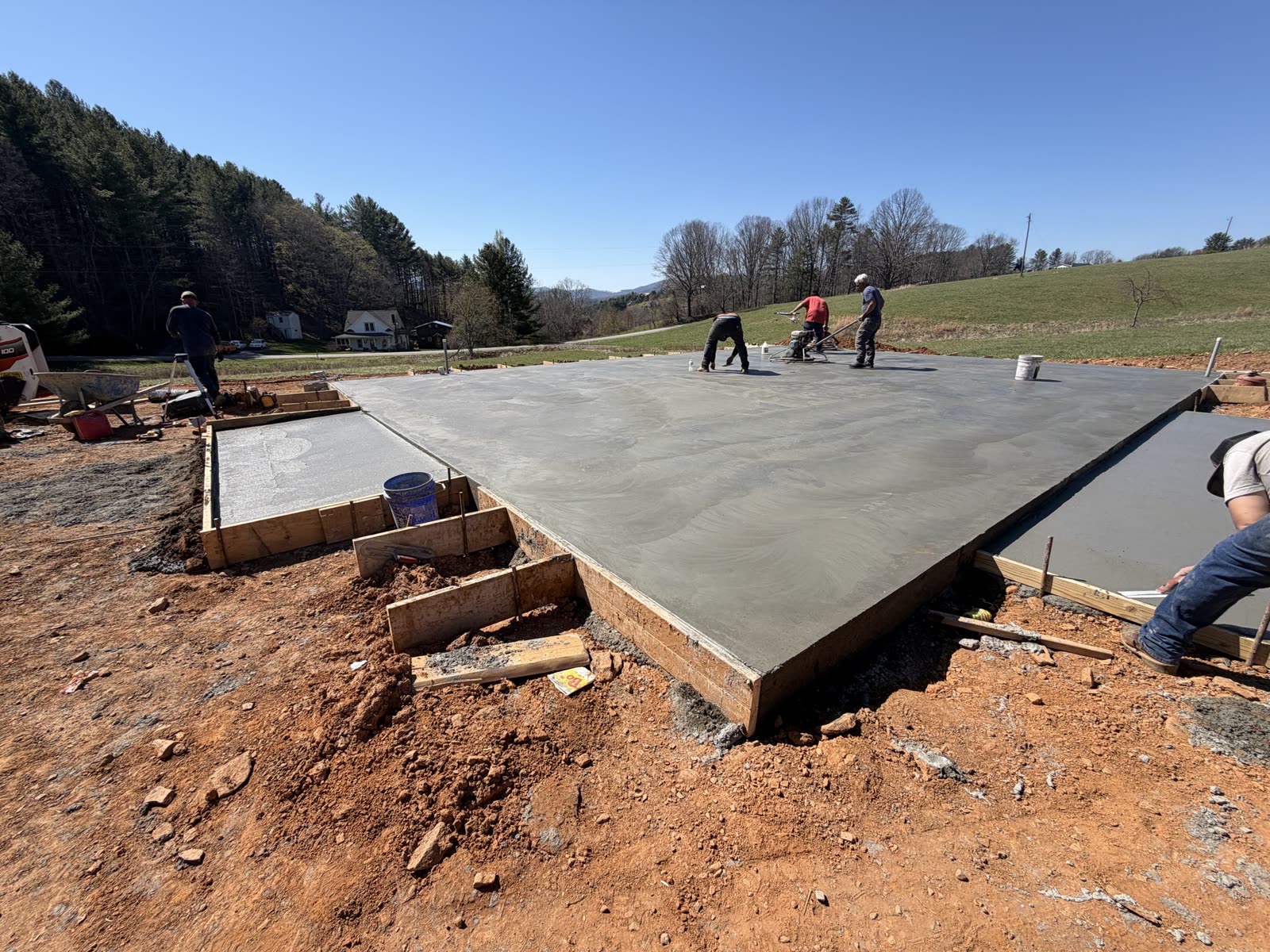
Concrete Slab & Foundation Work Guide for NC Mountain Homes
What to know about concrete slabs and foundations on sloped High Country lots — footing depth, drainage, curing time, and the warning signs of foundation trouble.
Everything Starts With the Foundation
Whether it's a slab for a new garage, a foundation for a home addition, or a concrete pad for equipment, the work that goes on before the pour matters as much as the concrete itself. Soil prep, drainage planning, and footing depth determine whether a slab stays solid for decades or starts cracking and settling within a few years.
Site prep on a sloped lot
Very few building sites in the High Country offer naturally flat, well-drained ground. Before any concrete goes down, the site typically needs cutting and filling to create a level pad, along with proper compaction of any fill soil. Skipping or rushing compaction is one of the most common causes of slab cracking and uneven settling down the road — the concrete itself can be done perfectly and still fail if the ground underneath it wasn't prepared correctly.
Footing depth and local codes
Footing depth depends on the local frost line and the soil's bearing capacity, both of which are set by county building code. Mountain elevations can call for deeper footings than lower-elevation parts of the state, so it's worth confirming the requirement with local building officials before finalizing a foundation plan rather than assuming a standard depth will apply everywhere.
Drainage around the foundation
Water is the biggest long-term threat to any concrete foundation. Grading the site so water flows away from the slab, and in some cases adding a footing drain, helps prevent water from pooling against the foundation and causing frost heave, erosion underneath the slab, or hydrostatic pressure against a wall. This is especially important on sloped lots where runoff naturally wants to collect at the low point near a structure.
Curing time before use
Concrete typically reaches enough strength to walk on within a day or two, but it keeps curing for about 28 days before reaching its full design strength. Heavier loads — like parking a vehicle on a new driveway slab — should generally wait at least a week after the pour, longer in cool weather, to avoid cracking before the concrete has had a chance to cure properly.
Signs of foundation trouble to watch for
- Cracks wider than a hairline, particularly ones that run diagonally or grow over time
- Doors or windows that stick or no longer close square
- Sloping or noticeably uneven floors
- Gaps opening up between walls, ceilings, or trim
Any of these are worth having inspected sooner rather than later, since foundation problems tend to get more expensive to correct the longer they're left unaddressed. Riverfront Group has handled concrete and foundation work as part of general contracting projects throughout the High Country since 2019. For a related look at keeping water away from your foundation, see our yard drainage guide, or learn about garage and outbuilding foundations. Reach out below for an on-site evaluation of your site and soil conditions.
Planning a concrete slab or worried about your foundation?
Call Adam for an on-site look at your soil, slope, and drainage before you commit to a foundation plan.